


Understanding the role of a transformer core
2020-10-28
Transformer cores are made from various materials, commonly including silicon steel sheets and ferrites. However, commonly used transformer cores are generally made of silicon steel sheets. Silicon steel is a type of steel containing silicon (also known as silicium), with a silicon content of 0.8% to 4.8%. Silicon steel is used for transformer cores because it is a highly conductive magnetic material that can generate a high magnetic induction intensity in energized coils, thus reducing the size of the transformer. In AC operation, power loss in a transformer occurs not only in the coil resistance but also in the core under alternating current magnetization. The power loss in the core is usually called "iron loss," caused by "hysteresis loss" and "eddy current loss."
Hysteresis loss is the iron loss generated due to hysteresis during the magnetization of the core. The magnitude of this loss is proportional to the area enclosed by the material's hysteresis loop. Silicon steel has a narrow hysteresis loop, resulting in lower hysteresis loss when used in transformer cores, significantly reducing heat generation.
When a transformer operates, the magnetic flux generated by the alternating current in the coil is naturally alternating. The changing magnetic flux induces eddy currents in the core. These eddy currents circulate in a plane perpendicular to the magnetic flux direction, hence the name eddy current. Eddy current loss also causes core heating. To reduce eddy current loss, transformer cores are made of stacked silicon steel sheets insulated from each other. This confines the eddy currents to narrow loops, increasing the resistance of the eddy current path; simultaneously, the silicon in the silicon steel increases the material's resistivity, further reducing eddy currents.
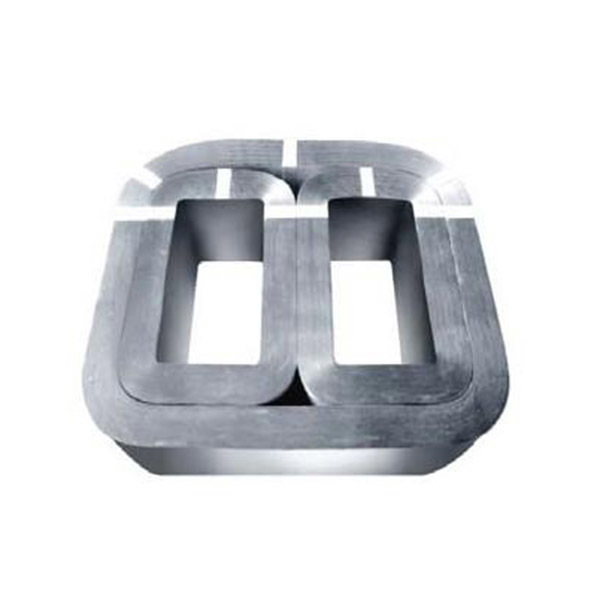
Transformer cores typically use 0.35 mm thick cold-rolled silicon steel sheets. These sheets are cut into strips according to the required core size and then stacked into a "日" or "口" shape. Theoretically, to minimize eddy currents, thinner silicon steel sheets and narrower strips are better. This reduces eddy current loss, lowers temperature rise, and saves material. However, in practice, manufacturing silicon steel cores doesn't solely focus on these advantages, as it would significantly increase labor time and reduce the effective cross-sectional area of the core. Therefore, when making transformer cores with silicon steel sheets, a balance must be struck between various factors to choose the optimal size.
Transformer cores primarily serve to conduct magnetism, enabling magnetic-electric conversion. The main function of a transformer core is to conduct magnetism and provide a framework. As a magnetic component in a constantly changing electromagnetic field, the magnetization intensity and magnetic induction intensity of the core are also constantly changing. With a core, the primary and secondary coils can achieve better mutual inductive coupling.
Next:
Recommended News
Contact Us
Online Message
* Note: Please fill in the information accurately and keep the communication open. We will contact you as soon as possible.