


Classification and Applications of Transformer Core Materials
2020-10-28
Structure and characteristics of transformer cores
Core types and applications:
The core serves as both the magnetic circuit and the mechanical framework of the transformer. It consists of core columns and yokes. Windings are placed on the core columns, and the yokes connect the core columns to form a closed magnetic circuit. Yokes are divided into top yokes, bottom yokes, and side yokes.
To reduce hysteresis and eddy current losses in the core, it is generally made of high-permeability silicon steel sheets. Silicon steel sheets are available in hot-rolled and cold-rolled types, with thicknesses of 0.35 mm and 0.5 mm. A 0.01-0.13 mm thick insulating coating is applied to both sides of the silicon steel sheets to isolate them from each other.
Based on structural form and process characteristics, transformer cores can be divided into laminated and unwound types. Laminated cores are further divided into core-type and shell-type.
Classification of laminated cores:
1. Shell-type structure
In a shell-type structure, the yoke surrounds the top, bottom, and sides of the windings. The characteristic of a shell-type transformer is that it has top, bottom, and side yokes.
For large-capacity three-phase transformers, due to transportation limitations, it is necessary to reduce the core height. Part of the top and bottom yokes of a conventional three-phase core transformer are moved to the outer sides of the two side columns, resulting in a three-phase five-column core structure.
2. Core-type structure
In a core-type structure, the yoke is against the top and bottom of the windings but does not surround the sides. Shell-type structures have better mechanical strength but are more complex to manufacture and use more core material. Core-type structures are simpler, and winding assembly and insulation processing are easier. Therefore, domestically produced power transformers generally adopt core-type structures.
Unwound core:
An unwound core consists of core columns and yokes. The core columns are formed by inserting unwound, similarly sized silicon steel sheets into a cylindrical shape. The ratio of the outer diameter to the inner diameter of the core column is 4.5-6. These unwound silicon steel sheets are individually rolled using cold extrusion plastic deformation principles on specialized forming machines. For three-phase transformers, the advantages of unwound cores over laminated cores are that the three-phase magnetic circuits are completely symmetrical, and silicon steel material can be saved.
Classification of transformer core materials
Cores are classified by application into high-frequency, low-frequency, and COIL types:
1. High-frequency type: Ferrite core
Ferrite cores are used in high-frequency transformers. They are a kind of ceramic magnetic material with a spinel crystal structure. This spinel is composed of iron oxide and other divalent metal compounds, such as kFe2O4 (k represents other metals). Commonly used metals include manganese (Mn), zinc (Zn), nickel (Ni), magnesium (Mg), and copper (Cu).
Common combinations include manganese-zinc (MnZn) series, nickel-zinc (NiZn) series, and magnesium-zinc (MgZn) series. This material has high permeability and impedance properties, with a usable frequency range from 1 kHz to over 200 kHz.
2. Low-frequency type: Silicon steel sheet (LAMINATION)
Silicon steel sheets are used in low-frequency transformers. There are many types, which can be divided according to their manufacturing process:
A: Sintered (black sheet)
N: Unsintered (white sheet)
According to their shape, they can be divided into: EI type, UI type, C type, and U type.
U-shaped silicon steel sheets are often used in higher-power transformers. They have good insulation properties, are easy to dissipate heat, and prevent magnetic short circuits. They are mainly used in transformers with power greater than 500-1000W and high-power transformers.
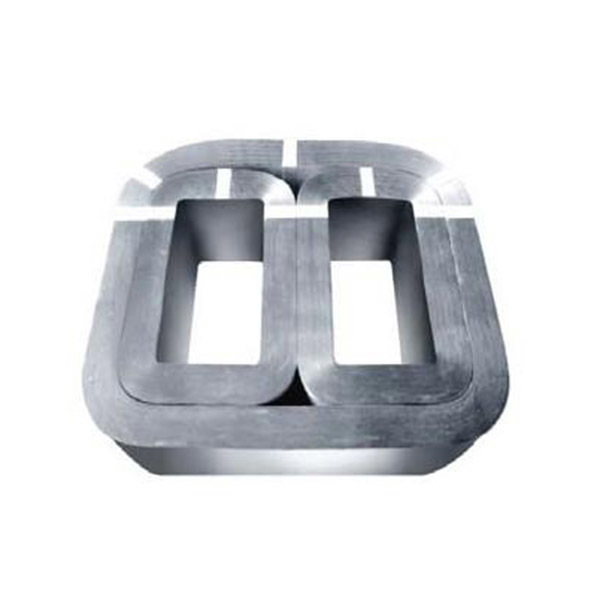
Two C-shaped silicon steel sheets form a set of CD-type silicon steel sheets. In power supply transformers made with CD-type silicon steel sheets, under the condition of the same cross-sectional area, the higher the window height, the greater the transformer power. Coils can be installed on both sides of the core, so the number of turns of the transformer coil can be distributed on two windings, thus shortening the average length of each winding and reducing the copper loss of the coil. In addition, if two coils requiring symmetry are wound on two windings respectively, a completely symmetrical effect can be achieved.
Four C-shaped silicon steel sheets form a set of ED-type silicon steel sheets. Transformers made with ED-type silicon steel sheets have a flat and wide shape. Under the condition of the same power, ED-type transformers are shorter and wider than CD-type transformers. In addition, because the coils are installed in the middle of the silicon steel sheets, there is an external magnetic circuit, so the leakage magnetic flux is small, and the overall interference is small. However, all coils are wound on one winding, the winding is thicker, so the average turn length is longer, and the copper loss is larger.
Transformers made with C-type cores have excellent performance, small size, light weight, and high efficiency. From the assembly point of view, C-type silicon steel sheets have few parts and strong versatility, so the production efficiency is high. However, C-type silicon steel sheets have more processing procedures and are more complex to manufacture, requiring specialized equipment. Therefore, the current cost is still relatively high.
We mainly use EI-type silicon steel sheets. E-type silicon steel sheets are also called shell-type or Japanese-type silicon steel sheets. Their main advantages are that the primary and secondary coils share one frame, with a high window utilization factor (window utilization factor Km: ratio of net copper wire cross-sectional area to window area); the silicon steel sheets form a protective shell for the windings, making the windings less susceptible to mechanical damage; at the same time, the silicon steel sheets have a large heat dissipation area, and the transformer magnetic field dispersion is less. However, their primary and secondary leakage inductance is larger, and the interference from external magnetic fields is also larger. In addition, because the average winding length is longer, under the same number of turns and core cross-sectional area conditions, EI-type cores use more copper wire.
Commonly used thicknesses of silicon steel sheets are 0.35 mm and 0.5 mm.
There are two methods for assembling silicon steel sheets: overlapping and interleaving. The overlapping method involves alternating the openings of the silicon steel sheets on both sides. This method is more complicated, but it results in smaller gaps between the sheets, lower magnetic resistance, and facilitates increased magnetic flux. Therefore, this method is used in power transformers. The interleaving method is often used in applications with direct current to avoid saturation caused by direct current. Gaps are needed between the silicon steel sheets, so the E and I sheets are placed on opposite sides in the interleaving method, and the gap between them can be adjusted with paper sheets.
3. COIL types: There are three types
A. TOROIDAL core: Made by stacking O-shaped laminations or by winding silicon steel sheets. This type of core is very difficult to wind.
B. ROD CORE
C. DRUM CORE
Transformer Core Material Function
The function of the transformer core is mainly in two aspects: hysteresis loss and eddy current loss:
1. Hysteresis loss refers to the iron loss caused by hysteresis when the transformer operates in an AC state. The use of a transformer core can change this phenomenon to a certain extent and alleviate the surface temperature rise of the transformer during operation.
2. Eddy current loss refers to the alternating current generated when the transformer is operating. It changes with the induced current generated by the magnetic flux in the core. This change is called eddy current. When the eddy current is lost, the temperature of the core surface rises. However, due to the material (silicon) of the core, the resistivity increases during this process, thereby reducing the effect of eddy current.
Transformer Core Troubleshooting
The windings and core of a transformer are the main components for transmitting and transforming electromagnetic energy. Ensuring their reliable operation is a concern. Statistics show that core-related failures account for the third largest proportion of total transformer failures. Manufacturers have paid attention to core defects and have made technical improvements in aspects such as reliable grounding, core grounding monitoring, and ensuring single-point grounding. Operation departments also attach great importance to detecting and identifying core faults. However, transformer core failures still occur frequently, mainly due to multiple-point grounding and poor grounding of the core. This article introduces the judgment and handling methods for these two fault conditions.
1. Reason for single-point grounding of the core under normal conditions
During normal operation of the transformer, an electric field exists between the energized windings and the tank, and the core and other metal components are in this electric field. Due to uneven capacitance distribution and varying field strength, if the core is not reliably grounded, charging and discharging phenomena will occur, damaging the solid insulation and reducing the insulation strength of the oil. Therefore, the core must be reliably grounded at one point.
The core is composed of silicon steel sheets. To reduce eddy currents, there is a certain insulation resistance between the sheets (generally only a few ohms to tens of ohms). Due to the extremely large capacitance between the sheets, it can be regarded as a conductive path in an alternating electric field. Therefore, only one point grounding of the core is needed to clamp the potential of the entire stack of core laminations to the ground potential.
When the core or its metal components have two or more grounding points (multiple-point grounding), a closed loop will be formed between the grounding points, which will link part of the magnetic flux, induce electromotive force, and form a loop, causing local overheating and even burning the core.
Only single-point grounding of the transformer core is reliable and normal grounding. That is, the core must be grounded, and it must be single-point grounded.
Core failures are mainly caused by two reasons: poor construction process causing short circuits, and multiple-point grounding caused by accessories and external factors.
2. Types of multiple-point grounding of the core
(1) After the installation of the transformer is completed, the positioning pins for transportation on the top cover of the tank are not turned over or removed, resulting in multiple-point grounding.
(2) Due to the clamping piece limb plate being too close to the core column, or the core laminations being lifted for some reason and touching the clamping piece limb plate, multiple-point grounding is formed.
(3) The bushing of the yoke screw is too long and touches the yoke laminations, forming a new grounding point.
(4) The insulation board between the lower clamping piece foot and the yoke falls off or is damaged, causing the laminations at the foot of the yoke to touch and cause grounding.
(5) In large and medium-sized transformers with submersible pump devices, due to wear and tear of the submersible pump bearings, metal powder enters the tank, accumulates at the bottom of the tank, and forms a bridge under the action of electromagnetic force, connecting the lower yoke and foot or tank bottom, forming multiple-point grounding.
(6) The thermometer seat sleeve on the oil tank cover of the oil-immersed transformer is too long and touches the upper clamp or yoke and the edge of the side column, forming a new grounding point.
(7) Metal foreign objects fall into the oil tank of the oil-immersed transformer, and these metal foreign objects connect the core laminations and the tank body, forming grounding.
(8) The wooden spacer between the lower clamp and the yoke step is damp or unclean, with a lot of oil sludge attached, causing its insulation resistance to drop to zero, forming multiple-point grounding.
3. Abnormal phenomena occurring during multiple-point grounding
(1) Eddy currents are generated in the core, iron loss increases, and the core is locally overheated.
(2) When multiple-point grounding is serious and not handled for a long time, continuous operation of the transformer will also cause overheating of the oil and windings, causing the oil-paper insulation to gradually age. This can cause the insulation layer between two core laminations to age and fall off, causing greater core overheating and burning the core.
(3) Multiple-point grounding for a long time causes the oil in the oil-immersed transformer to deteriorate and produce combustible gas, causing the gas relay to operate.
(4) Core overheating causes carbonization of wooden spacers and clamps in the transformer body.
(5) Severe multiple-point grounding can cause the grounding wire to burn out, causing the transformer to lose its normal single-point grounding, with unimaginable consequences.
Multiple grounding points can also cause discharge phenomena.
4. Detection of Multiple Grounding Point Faults
The judgment method for multiple grounding point faults in the iron core is usually detected from two aspects:
(1) Conduct gas chromatography analysis. In chromatographic analysis, if the content of methane and olefin components in the gas is high, while the content of carbon monoxide and carbon dioxide gas changes little compared with the past, or the content is normal, it indicates that the iron core is overheated, and the overheating of the iron core may be caused by multiple grounding points.
When acetylene gas appears in chromatographic analysis, it indicates that the iron core has intermittent multiple grounding points.
(2) Measure whether there is current in the grounding wire. A clamp meter can be used to measure whether there is current on the grounding lead of the grounding sleeve externally connected to the transformer iron core. When the transformer iron core is normally grounded, no current loop is formed. The current on the grounding line is very small, in the milliampere level (generally less than 0.3A). When there is multiple grounding points, the surrounding of the main magnetic flux of the iron core is equivalent to the existence of a short-circuited turn, and a circulating current flows in the turn, the value of which is determined by the relative position of the fault point and the normal grounding point, that is, how much magnetic flux is enclosed in the short-circuited turn. It can generally reach tens of amperes. By measuring whether there is current in the grounding lead, it can accurately determine whether there is a multiple grounding fault in the iron core.
5. Elimination of Multiple Grounding Point Faults
(1) Temporary elimination methods when the transformer cannot be shut down:
① If there is an externally connected grounding wire, if the fault current is large, the grounding wire can be temporarily opened for operation. However, it is necessary to strengthen monitoring to prevent the iron core from appearing at a floating potential after the fault point disappears.
② If the multiple grounding fault is unstable, a sliding rheostat can be inserted into the working grounding line to limit the current to less than 1A. The selection of the sliding rheostat is to divide the voltage measured by opening the normal working grounding line by the current on the grounding line.
③ The gas production rate of the fault point should be monitored by chromatographic analysis.
④ After finding the exact fault point through measurement, if it cannot be handled, the normal working grounding plate of the iron core can be moved to the same position as the fault point to significantly reduce the circulating current.
(2) Thorough overhaul measures. After monitoring finds that the transformer has a multiple grounding fault, for transformers that can be shut down, they should be shut down in time and thoroughly eliminate the multiple grounding fault after withdrawal. The methods for eliminating this type of fault should adopt corresponding overhaul measures according to the type and cause of multiple grounding. However, in some cases, the fault point cannot be found after the power is cut off and the core is lifted. In order to accurately find the grounding point, the following methods can be used on site.
① DC method. Open the connecting plates of the iron core and the clamp, and apply 6V DC to the silicon steel sheets on both sides of the yoke, and then use a DC voltmeter to measure the voltage between each level of silicon steel sheets in turn. When the voltage is zero or the meter indicates the reverse direction, it can be considered that this is the fault grounding point.
② AC method. Connect the low-voltage winding of the transformer to an AC voltage of 220~380V. At this time, there is magnetic flux in the iron core. If there is a multiple grounding fault, a current will appear when measured with a milliammeter (the connecting plates of the iron core and the clamp should be opened). Measure point by point along the iron yoke with a milliammeter. When the current in the milliammeter is zero, the fault point is at that point.
Recommended News
Contact Us
Online Message
* Note: Please fill in the information accurately and keep the communication open. We will contact you as soon as possible.